Poms
Old Possum's Book of Practical CatsThe Poms are presented as a collective rather than as individually distinguished dogs in The Awefull Battle of the Pekes and the Pollicles. Their part in the episode is brief but sharply staged: they are said not to favor fighting, join the clamor from balconies and roofs, and scatter when the Great Rumpuscat makes his entrance. That movement from distance to participation and then sudden retreat gives the Poms a clear place in the poem’s comic account of a quarrel that grows beyond its original opponents.
Identity and Position
The Poms enter the account as one of two additional dog groups, named alongside the Pugs. The poem distinguishes them from the central feud between the Pekes and the Pollicles: those two groups are described as implacable, passionate foes, while the Pugs and Poms are characterized by a more reluctant relationship to fighting. The contrast makes the Poms participants in a wider neighborhood disturbance, not one of the feud’s defining parties.
The evidence gives the Poms no individual names, leader, or separate point of view. Their identity is collective, and their contribution is conveyed through shared movement and sound. They are not described as having a particular reason for joining, nor is a personal grievance assigned to them. What matters in the episode is the change in their public behavior: a group reputed to dislike fighting nevertheless becomes part of the commotion.
A Reputation Tested by the Fray
The poem introduces the Poms with a qualification: most people say that they do not like fighting, but they will occasionally join in. This is not an absolute claim that they are always peaceful. Its wording leaves room for a familiar exception, and the battle supplies one. The Poms’ action does not erase their stated reluctance; instead, the incident turns the exception into a comic spectacle.
Their contrast with the Pekes and Pollicles helps define the scale of the disturbance. The two principal groups are presented as enduring enemies, locked in a recurring antagonism that persists wherever they meet. The Poms, by contrast, are described as occasional entrants into a fight. The poem thus expands the conflict without making every group equally committed to it: the Poms add to the disorder, but the account does not recast them as the feud’s original cause or most determined combatants.
Joining the Noise
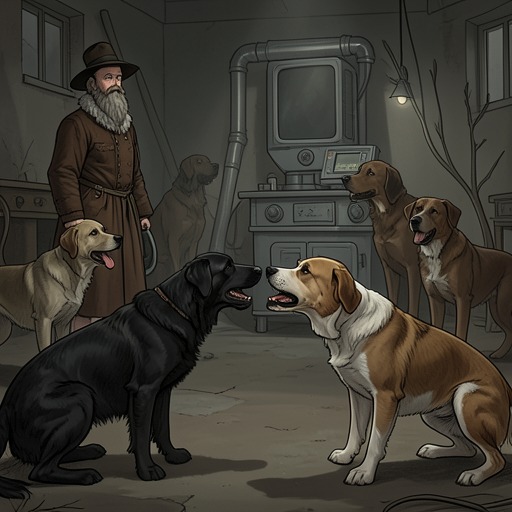
The Poms’ participation becomes visible after the opposing groups have stepped out with pipers playing “When the Blue Bonnets Came Over the Border.” At this point, the Pugs and Poms no longer remain aloof. Some join from the balcony and some from the roof, positions that place them around the scene rather than at its center. The poem describes them joining the din, turning their entry into a shift from watching or holding back to taking part in the uproar.
Sound, rather than a particular act of fighting, marks what the Poms contribute. Their collective barking is rendered in an escalating pattern of repeated barks, with the final barks given greater force. The noise grows until it can be heard all over the Park. This makes the Poms part of the battle’s widening public disturbance, even though the account does not specify an individual attack by any Pom or identify a particular opponent they target.
The sequence gives their participation a comic, almost musical form: the pipers’ tune is followed by a chorus of barking, and the repeated sound carries the quarrel beyond the immediate groups. The Poms are not given a speech or personal motive. Instead, the poem uses their entrance as a collective contribution to the scene’s rising volume. Neighbors become so frightened by the din that they begin ringing up the Fire Brigade, a consequence of the gathering commotion rather than an action attributed specifically to the Poms.
The Great Rumpuscat and the Retreat
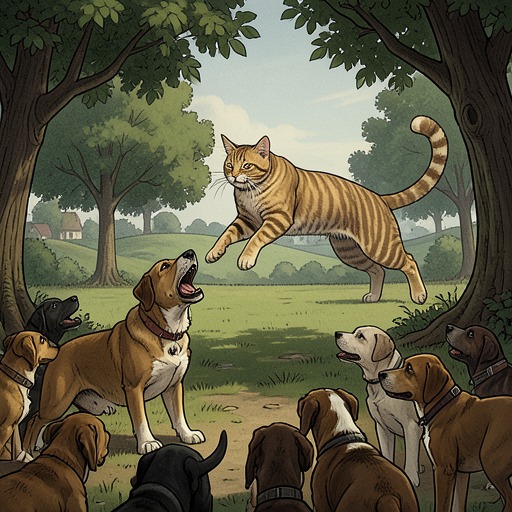
The Poms’ moment in the fray ends when the Great Rumpuscat stalks out of a small basement flat. His blazing, fireball-like eyes and yawning create a sudden change in the scene: the noise of the assembled dogs gives way to alarm at a single formidable arrival. The poem then has him look at the sky and leap, after which every one of the dogs scatters like sheep. The Poms are included in that collective flight; the account does not single them out for a distinct response.
This reversal tests the Poms’ temporary willingness to join the uproar. Their participation helps swell the disturbance, but it does not establish them as fearless or as opponents capable of standing against the Great Rumpuscat. Once he appears, the shared barking and the enlarged crowd give way to dispersal. The episode therefore closes their part in the conflict not with victory or defeat in the original feud, but with the collapse of the assembled dogs’ noisy bravado.
Narrative Role
The Poms help the poem turn a rivalry between the Pekes and the Pollicles into a progressively broader neighborhood spectacle. Their stated dislike of fighting, their occasional willingness to join, and their entry from elevated positions make them a recognizable supporting group: peripheral to the feud, yet consequential to the scale of its noise. Their barking helps carry the disturbance across the Park and contributes to the neighbors’ alarm.
Their role also sharpens the scene’s reversal. First the Poms join the din; then the Great Rumpuscat’s appearance makes the assembled dogs scatter. The rapid movement from joining in to fleeing gives the episode its compact comic arc and underscores the difference between noisy collective participation and the authority of the figure who can end it. The poem supplies no later account of the Poms, so their narrated part concludes with that retreat.